Friday, August 8, 2008


Stern's Ely Lecture on Climate Change and DIscounting

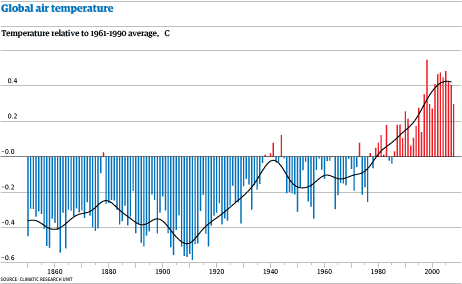
I just finished reading Prof. Stern's Ely Lecture ( Stern, Nicholas. 2008. "The Economics of Climate Change", American Economic Review 98(2), pp. 1-37.). He is in favor of drastic measures to reduce CO2 emissions. Concentrations are now 430 ppm and he wants to stabilize them at 550 ppm. He is fearful of a 5 degree Centigrade temperature increase otherwise. Here are my notes.

1. He says the most recent warm period was around 3 million years ago. Really? There have been lots of ice ages and warmings.

2. He dismisses geoengineering in one paragraph with weak arguments.

3. His Figure 4 from McKinsey has lots of *negative* abatement costs-- things such as insulation improvement, fuel-efficient commercial vehicles, water heating, etc. We can't believe any of that. If it saves money, why isn't it done already? Liquidity constraints?

4. (p. 13). He cites 1.5% as the indexed bonds rate of return on longterm government bonds, and 6-7 percent for private investments:

In the United Kingdom and United States, we find (relatively) “riskless,” indexed lending rates on government bonds centered around 1.5 percent over very long periods. For private very long-run rates of return on equities, we find rates centered around 6 or 7 percent (Rajnish Mehra and Edward C. Prescott 2003, 892; Kenneth J. Arrow et al. 2004, 156; Sree Kochugovindan and Roland Nilsson 2007a, 64; 2007b, 71).
He has a puzzling sentence about what discount rate to use:
Given that it is social discount rates that are at issue, and also that actions to reduce carbon are likely to be financed via the diversion of resources from consumption (via pricing) rather than from investment, it is the long-run riskless rates associated with consumer decisions that have more relevance than those for the investment-related equities.
This is a good question, but what is the implication? Consumers are willing to borrow at rates on the order of 10%, so is that the appropriate social discount rate?

He makes the point that environmental goods' prices will change (though he does not point out that those goods are a tiny part of the consumption basket):

Suppose, however, that we persisted with the argument that it is better to invest at 6-7 percent and then spend money on overcoming the problems of climate change later rather than spending money now on these problems. The multi-good nature of the problem, together with the irreversibilities from GHG accumulation and climate change, tell us that we would be making an additional mistake. The price of environmental goods will likely have gone up very sharply, so that our returns from the standard types of investment will buy us much less in reducing environmental damage than resources allocated now (see also Section I on the costs of delay).12 This reflects the result that if environmental services are declining as stocks of the environment are depleted, then the SDR with that good as numeraire will be negative. On this, see the interesting work by Michael Hoel and Thomas Sterner (2007), Sterner and U. Martin Persson (2007) and Roger Guesnerie (2004), and also the Stern Review (Stern 2007, 60). Environmental services are also likely to be income elastic, which will further reduce the implied SDR.
He has some useful sources on the appropriate rate of pure utility time preference:
Indeed, the ethical proposition that delta should be very small or zero has appealed to a long line of illustrious economists including Frank P. Ramsey (1928, 543), Arthur Cecil Pigou (1932, 24–5), Roy F. Harrod (1948, 37–40), Robert M. Solow (1974, 9), James A. Mirrlees (Mirrlees and Stern 1972), and Amartya Sen (Sudhir Anand and Sen 2000). I have heard only one ethical argument for positive delta (Wilfred Beckerman and Hepburn 2007; Simon Dietz, Hepburn, and Stern 2008) that has some traction—namely a temporal interpretation of the idea that one will have stronger fellow feelings for those closer to us (such as family or clan) relative to those more distant.
When it came to choosing a social discount rate, Stern is opposed to using market interest rates. Later, though, when it comes to choosing the appropriate amount of equality and income redistribution, he slyly switches to favoring observed amounts:
Value judgements are, of course, precisely that and there will be many different positions. They will inevitably be important in this context— they must be discussed explicitly and the implications of different values should be examined. Examples follow of what we find when we turn to empirical evidence and try to obtain implied values (the “inverse optimum” approach). Empirical evidence can inform, but not settle, discussions about value judgements... The upshot is that empirical estimates of implied welfare weights can give a wide range of eta, including h below one and even as little as zero.
Here he is trying to squirm out of the powerful growing-income argument against a low social discount rate. The argument goes like this. Suppose we are considering taking $1,000 away from someone earning $40,000/year so we can give $1,600 to someone else earning $107,000/year. Should we do it? Despite the increase in social wealth, it seems unfair and not calculated to increase total happiness. Yet that is what happens when we require $1,000 in abatement costs in in 2008 because it has a 1%/year return in benefits obtained in 50 years, if incomes grow at 2%/year in the meantime. This argument is particularly powerful against liberals, though it works for conservatives too, and lays out starkly the forced transfers that libertarians hate.

There is a lot of posturing going on:

Costa Rica, New Zealand, and Norway, declared targets of 100 percent reductions by 2050, i.e., “going carbon-neutral.” ... California has a target of 80 percent reductions by 2050. France has its “Facteur Quatre”: dividing by 4, or 75 percent reductions, by 2050 (Stern 2007, 516). The United Kingdom has a 60 percent target but the Prime Minister Gordon Brown indicated in November 2007 that this could be raised to 80 percent (Brown 2007). Australia, under the new government elected at the end of November 2007, has now signed Kyoto and has a target of 60 percent...
Costa Rica doesn't matter of course, any more than the United Kingdom does, or anybody else but China and India:
Even with fairly conservative estimates, it is likely that, under BAU, China will reach current European per capita emissions levels within 20-25 years. With its very large population, over this time China under BAU will emit cumulatively more than the USA and Europe combined over the last 100 years.
"BAU" means "business as usual".

Labels: , ,


To view the post on a separate page, click at (the permalink). 0 Comments Links to this post

Wednesday, August 6, 2008


Barick Obama's Economic Policies

From Obama for President website, here are some of his economic policies, with my commentary.
* Provide Additional Tax Rebates to American Workers: The economy has continued to weaken significantly, despite congressional action to provide immediate tax rebates to American consumers. Stimulus: $20 billion.
Good. Taxes are tending to increase, so cutting them is good, even if the tax cut is called a rebate.
* Establish a $10 billion Foreclosure Prevention Fund: Given the downturn in the economy, Obama is calling for immediate creation of his Foreclosure Prevention Fund that will dramatically increase emergency pre-foreclosure counseling, and will help families facing foreclosure to responsibly refinance their mortgages or sell their homes. Obama’s plan will not help speculators, people buying vacation homes or people that falsely represented their incomes. It is meant to help responsible homeowners through this difficult period. Stimulus: $10 billion.
Bad. People who are overextended are given plenty of time by their banks, who lose money from foreclosures. The industry of reckless lending should not be subsidized this way.
* Provide $10 billion in Relief for State and Local Governments Hardest-Hit by the Housing Crisis to Prevent Cuts in Vital Services: Because of the housing crisis and the weakening economy, many state and local governments are facing significant revenue shortfalls. Barack Obama believes that in the areas hardest-hit by the housing crisis we should provide immediate, temporary funding to state and local governments so that the decline in property values does not cause them to slash critical public services and cut vital infrastructure spending. Stimulus: $10 billion.
Bad. Localities can raise their own taxes if they want to, rather than using national taxes.
* Extend and Expand Unemployment Insurance: Barack Obama believes we must extend and strengthen the Unemployment Insurance (UI) program to address the needs of the long-term unemployed, who currently make up nearly one-fifth of the unemployed and are often older workers who have lost their jobs in manufacturing or other industries and have a difficult time finding new employment. Expanding UI is one of the most effective ways to combat economic turmoil; every dollar invested in UI benefits results in $1.73 in economic output. Obama is calling for a temporary expansion of the UI program for those who have exhausted their current eligibility. Stimulus: $10 billion.
Bad. We shouldn't encourage people to stay unemployed.
* Provide a Tax Cut for Working Families: Obama will restore fairness to the tax code and provide 150 million workers the tax relief they need. Obama will create a new "Making Work Pay" tax credit of up to $500 per person, or $1,000 per working family. The "Making Work Pay" tax credit will completely eliminate income taxes for 10 million Americans.
Bad. We've already done too much of this. It's good for everyone to contribute at least a little in income tax. Also, this plan does exactly what the Earned Income Credit is supposed to be doing already.
* Eliminate Income Taxes for Seniors Making Less than $50,000: Barack Obama will eliminate all income taxation of seniors making less than $50,000 per year. This proposal will eliminate income taxes for 7 million seniors and provide these seniors with an average savings of $1,400 each year. Under the Obama plan, 27 million American seniors will also not need to file an income tax return.
Bad. Why should old people get a special tax break?
* Simplify Tax Filings for Middle Class Americans: Obama will dramatically simplify tax filings so that millions of Americans will be able to do their taxes in less than five minutes. Obama will ensure that the IRS uses the information it already gets from banks and employers to give taxpayers the option of pre-filled tax forms to verify, sign and return. Experts estimate that the Obama proposal will save Americans up to 200 million total hours of work and aggravation and up to $2 billion in tax preparer fees.
Good idea.
* Fight for Fair Trade: Obama will fight for a trade policy that opens up foreign markets to support good American jobs. He will use trade agreements to spread good labor and environmental standards around the world and stand firm against agreements like the Central American Free Trade Agreement that fail to live up to those important benchmarks. Obama will also pressure the World Trade Organization to enforce trade agreements and stop countries from continuing unfair government subsidies to foreign exporters and nontariff barriers on U.S. exports.

* Amend the North American Free Trade Agreement: Obama believes that NAFTA and its potential were oversold to the American people. Obama will work with the leaders of Canada and Mexico to fix NAFTA so that it works for American workers.

Bad. He's a protectionist.
* Improve Transition Assistance: To help all workers adapt to a rapidly changing economy, Obama would update the existing system of Trade Adjustment Assistance by extending it to service industries, creating flexible education accounts to help workers retrain, and providing retraining assistance for workers in sectors of the economy vulnerable to dislocation before they lose their jobs.
Bad. Boondoggle spending.
* Invest in our Next Generation Innovators and Job Creators: Obama will create an Advanced Manufacturing Fund to identify and invest in the most compelling advanced manufacturing strategies. The Fund will have a peer-review selection and award process based on the Michigan 21st Century Jobs Fund, a state-level initiative that has awarded over $125 million to Michigan businesses with the most innovative proposals to create new products and new jobs in the state.

* Double Funding for the Manufacturing Extension Partnership: The Manufacturing Extension Partnership (MEP) works with manufacturers across the country to improve efficiency, implement new technology and strengthen company growth. This highly-successful program has engaged in more than 350,000 projects across the country and in 2006 alone, helped create and protect over 50,000 jobs. But despite this success, funding for MEP has been slashed by the Bush administration. Barack Obama will double funding for the MEP so its training centers can continue to bolster the competitiveness of U.S. manufacturers.

Bad. This is fascist industrial policy, the kind that was widely ridiculed in the 1980's. The government shouldn't be funding private investment.
* Invest In A Clean Energy Economy And Create 5 Million New Green Jobs: Obama will invest $150 billion over 10 years to advance the next generation of biofuels and fuel infrastructure, accelerate the commercialization of plug-in hybrids, promote development of commercial scale renewable energy, invest in low emissions coal plants, and begin transition to a new digital electricity grid. The plan will also invest in America's highly-skilled manufacturing workforce and manufacturing centers to ensure that American workers have the skills and tools they need to pioneer the first wave of green technologies that will be in high demand throughout the world.
Okay.
* Create New Job Training Programs for Clean Technologies: The Obama plan will increase funding for federal workforce training programs and direct these programs to incorporate green technologies training, such as advanced manufacturing and weatherization training, into their efforts to help Americans find and retain stable, high- paying jobs. Obama will also create an energy-focused youth jobs program to invest in disconnected and disadvantaged youth.
Bad. Industrial policy again.

[To be continued]

* Boost the Renewable Energy Sector and Create New Jobs: The Obama plan will create new federal policies, and expand existing ones, that have been proven to create new American jobs. Obama will create a federal Renewable Portfolio Standard (RPS) that will require 25 percent of American electricity be derived from renewable sources by 2025, which has the potential to create hundreds of thousands of new jobs on its own. Obama will also extend the Production Tax Credit, a credit used successfully by American farmers and investors to increase renewable energy production and create new local jobs. Barack Obama believes that it is critically important for the United States to rebuild its national transportation infrastructure – its highways, bridges, roads, ports, air, and train systems – to strengthen user safety, bolster our long-term competitiveness and ensure our economy continues to grow. * Create a National Infrastructure Reinvestment Bank: Barack Obama will address the infrastructure challenge by creating a National Infrastructure Reinvestment Bank to expand and enhance, not supplant, existing federal transportation investments. This independent entity will be directed to invest in our nation’s most challenging transportation infrastructure needs. The Bank will receive an infusion of federal money, $60 billion over 10 years, to provide financing to transportation infrastructure projects across the nation. These projects will create up to two million new direct and indirect jobs per year and stimulate approximately $35 billion per year in new economic activity. Technology, Innovation and Creating Jobs Barack Obama will increase federal support for research, technology and innovation for companies and universities so that American families can lead the world in creating new advanced jobs and products. * Invest in the Sciences: Barack Obama supports doubling federal funding for basic research and changing the posture of our federal government from being one of the most anti-science administrations in American history to one that embraces science and technology. This will foster home-grown innovation, help ensure the competitiveness of US technology-based businesses, and ensure that 21st century jobs can and will grow in America. * Make the Research and Development Tax Credit Permanent: Barack Obama wants investments in a skilled research and development workforce and technology infrastructure to be supported here in America so that American workers and communities will benefit. Obama wants to make the Research and Development tax credit permanent so that firms can rely on it when making decisions to invest in domestic R&D over multi-year timeframes. * Deploy Next-Generation Broadband: Barack Obama believes we can get broadband to every community in America through a combination of reform of the Universal Service Fund, better use of the nation's wireless spectrum, promotion of next-generation facilities, technologies and applications, and new tax and loan incentives. Support Small Business * Provide Tax Relief for Small Businesses and Start Up Companies: Barack Obama will eliminate all capital gains taxes on start-up and small businesses to encourage innovation and job creation. Obama will also support small business owners by providing a $500 “Making Work Pay” tax credit to almost every worker in America. Self-employed small business owners pay both the employee and the employer side of the payroll tax, and this measure will reduce the burdens of this double taxation. * Create a National Network of Public-Private Business Incubators: Barack Obama will support entrepreneurship and spur job growth by creating a national network of public-private business incubators. Business incubators facilitate the critical work of entrepreneurs in creating start-up companies. Obama will invest $250 million per year to increase the number and size of incubators in disadvantaged communities throughout the country. Labor Obama will strengthen the ability of workers to organize unions. He will fight for passage of the Employee Free Choice Act. Obama will ensure that his labor appointees support workers' rights and will work to ban the permanent replacement of striking workers. Obama will also increase the minimum wage and index it to inflation to ensure it rises every year. * Ensure Freedom to Unionize: Obama believes that workers should have the freedom to choose whether to join a union without harassment or intimidation from their employers. Obama cosponsored and is strong advocate for the Employee Free Choice Act, a bipartisan effort to assure that workers can exercise their right to organize. He will continue to fight for EFCA's passage and sign it into law. * Fight Attacks on Workers' Right to Organize: Obama has fought the Bush National Labor Relations Board (NLRB) efforts to strip workers of their right to organize. He is a cosponsor of legislation to overturn the NLRB's "Kentucky River" decisions classifying hundreds of thousands of nurses, construction, and professional workers as "supervisors" who are not protected by federal labor laws. * Protect Striking Workers: Obama supports the right of workers to bargain collectively and strike if necessary. He will work to ban the permanent replacement of striking workers, so workers can stand up for themselves without worrying about losing their livelihoods. * Raise the Minimum Wage: Barack Obama will raise the minimum wage, index it to inflation and increase the Earned Income Tax Credit to make sure that full-time workers earn a living wage that allows them to raise their families and pay for basic needs. Protect Homeownership and Crack Down on Mortgage Fraud Obama will crack down on fraudulent brokers and lenders. He will also make sure homebuyers have honest and complete information about their mortgage options, and he will give a tax credit to all middle-class homeowners. * Create a New FHA Housing Security Program: Barack Obama strongly supports the efforts of Senate Banking Committee Chair Chris Dodd (D–CT) to create a new Federal Housing Administration (FHA) program that will provide meaningful incentives for lenders to buy or refinance existing mortgages and convert them into stable 30-year fixed mortgages. This plan provides an important federal backstop – not a bailout – to this growing national problem. Neither lenders nor homeowners would receive a windfall from this plan. * Create a Universal Mortgage Credit: Obama will create a 10 percent universal mortgage credit to provide homeowners who do not itemize tax relief. This credit will provide an average of $500 to 10 million homeowners, the majority of whom earn less than $50,000 per year. * Ensure More Accountability in the Subprime Mortgage Industry: Obama has been closely monitoring the subprime mortgage situation for years, and introduced comprehensive legislation over a year ago to fight mortgage fraud and protect consumers against abusive lending practices. Obama's STOP FRAUD Act provides the first federal definition of mortgage fraud, increases funding for federal and state law enforcement programs, creates new criminal penalties for mortgage professionals found guilty of fraud, and requires industry insiders to report suspicious activity. * Mandate Accurate Loan Disclosure: Obama will create a Homeowner Obligation Made Explicit (HOME) score, which will provide potential borrowers with a simplified, standardized borrower metric (similar to APR) for home mortgages. The HOME score will allow individuals to easily compare various mortgage products and understand the full cost of the loan. * Create Fund to Help Homeowners Avoid Foreclosures: Obama will create a fund to help people refinance their mortgages and provide comprehensive supports to innocent homeowners. The fund will be partially paid for by Obama's increased penalties on lenders who act irresponsibly and commit fraud. * Close Bankruptcy Loophole for Mortgage Companies: Obama will work to eliminate the provision that prevents bankruptcy courts from modifying an individual's mortgage payments. Obama believes that the subprime mortgage industry, which has engaged in dangerous and sometimes unscrupulous business practices, should not be shielded by outdated federal law. Address Predatory Credit Card Practices Obama will establish a five-star rating system so that every consumer knows the risk involved in every credit card. He also will establish a Credit Card Bill of Rights to stop credit card companies from exploiting consumers with unfair practices. * Create a Credit Card Rating System to Improve Disclosure: Obama will create a credit card rating system, modeled on five-star systems used for other consumer products, to provide consumers an easily identifiable ranking of credit cards, based on the card's features. Credit card companies will be required to display the rating on all application and contract materials, enabling consumers to quickly understand all of the major provisions of a credit card without having to rely exclusively on fine print in lengthy documents. * Establish a Credit Card Bill of Rights to Protect Consumers: Obama will create a Credit Card Bill of Rights to protect consumers. The Obama plan will: o Ban Unilateral Changes o Apply Interest Rate Increases Only to Future Debt o Prohibit Interest on Fees o Prohibit "Universal Defaults" o Require Prompt and Fair Crediting of Cardholder Payments Reform Bankruptcy Laws Obama will reform our bankruptcy laws to protect working people, ban executive bonuses for bankrupt companies, and require disclosure of all pension investments. * Cap Outlandish Interest Rates on Payday Loans and Improve Disclosure: Obama supports extending a 36 percent interest cap to all Americans. Obama will require lenders to provide clear and simplified information about loan fees, payments and penalties, which is why he'll require lenders to provide this information during the application process. * Encourage Responsible Lending Institutions to Make Small Consumer Loans: Obama will encourage banks, credit unions and Community Development Financial Institutions to provide affordable short-term and small-dollar loans and to drive unscrupulous lenders out of business. * Reform Bankruptcy Laws to Protect Families Facing a Medical Crisis: Obama will create an exemption in bankruptcy law for individuals who can prove they filed for bankruptcy because of medical expenses. This exemption will create a process that forgives the debt and lets the individuals get back on their feet. Work/Family Balance Obama will double funding for after-school programs, expand the Family Medical Leave Act, provide low-income families with a refundable tax credit to help with their child-care expenses, and encourage flexible work schedules. * Expand the Family and Medical Leave Act: The FMLA covers only certain employees of employers with 50 or more employees. Obama will expand it to cover businesses with 25 or more employees. He will expand the FMLA to cover more purposes as well, including allowing workers to take leave for elder care needs; allowing parents up to 24 hours of leave each year to participate in their children's academic activities; and expanding FMLA to cover leave for employees to address domestic violence. * Encourage States to Adopt Paid Leave: As president, Obama will initiate a strategy to encourage all 50 states to adopt paid-leave systems. Obama will provide a $1.5 billion fund to assist states with start-up costs and to help states offset the costs for employees and employers. * Expand High-Quality Afterschool Opportunities: Obama will double funding for the main federal support for afterschool programs, the 21st Century Learning Centers program, to serve a million more children. Obama will include measures to maximize performance and effectiveness across grantees nationwide. * Expand the Child and Dependent Care Tax Credit: The Child and Dependent Care Tax Credit provides too little relief to families that struggle to afford child care expenses. Obama will reform the Child and Dependent Care Tax Credit by making it refundable and allowing low-income families to receive up to a 50 percent credit for their child care expenses. * Protect Against Caregiver Discrimination: Workers with family obligations often are discriminated against in the workplace. Obama will enforce the recently-enacted Equal Employment Opportunity Commission guidelines on caregiver discrimination. * Expand Flexible Work Arrangements: Obama will create a program to inform businesses about the benefits of flexible work schedules; help businesses create flexible work opportunities; and increase federal incentives for telecommuting. Obama will also make the federal government a model employer in terms of adopting flexible work schedules and permitting employees to request flexible arrangements. Barack Obama's Record * Housing: In the U.S. Senate, Obama introduced the STOP FRAUD Act to increase penalties for mortgage fraud and provide more protections for low-income homebuyers, well before the current subprime crisis began. * Predatory Lending: In the Illinois State Senate, Obama called attention to predatory lending issues. Obama sponsored legislation to combat predatory payday loans, and he also was credited with lobbying the state to more closely regulate some of the most egregious predatory lending practices. * American Jobs: Barack Obama introduced the Patriot Employer Act of 2007 to provide a tax credit to companies that maintain or increase the number of full-time workers in America relative to those outside the US; maintain their corporate headquarters in America; pay decent wages; prepare workers for retirement; provide health insurance; and support employees who serve in the military.

Labels: , ,


To view the post on a separate page, click at (the permalink). 0 Comments Links to this post


John McCain's Economic Policies

I've just been asked to sign an economists' letter of support for John McCain's economic plan. In general I don't like that kind of letter unless it's on some issue where pretty much all top economists can agree. Possibly there would be a consensus on the policy proposals mentioned in the letter itself, but McCain has some bad economic policy views not mentioned there.

First, what's in the letter. I've omitted the first and last "puff" parts.

His plan would control government spending by vetoing every bill with earmarks, implementing a constitutionally valid line-item veto, pausing non-military discretionary government spending programs for one year to stop their explosive growth and place accountability on federal government agencies.

Vetoing every bill with earmarks is a bad idea. He thereby throws away his bargaining power with Congress, and his ability to buy votes for important national-interest policies. Often a president needs to buy support for his foreign policy or trade policy by using earmarks.

The line-item veto would be good.

Pausing spending is bad. I don't know that most agencies' budgets have been growing too fast-- the big complaint is about earmarks.

His plan would keep taxes from rising, because higher tax rates are exactly the wrong policy to restore economic growth, especially at this time.

His plan would reduce tax rates by cutting the tax that corporations pay to 25 percent in line with other countries, by completely phasing out the alternative minimum tax, by increasing the exemption for dependents, by permitting the first-year expensing of new equipment and technology, and by making permanent a reformed tax credit for R&D.

That's pretty good. I'm not sure about eliminating the AMT, though, because it's a flat tax, which is a good thing.

His plan would also create a new and much simpler tax system and give Americans a free choice of whether to pay taxes under that simple system or the current complex and burdensome income tax.

That's a good idea.

His plan would open new markets for American goods and services and thereby create additional jobs for Americans by supporting good free trade agreements, such as the one with Colombia, and working with leaders around the world to avoid isolationism and protectionism. His plan would also reform education, retraining, and other assistance programs so they better help those displaced by trade and other changes in the economy. His plan addresses problems in the financial markets and housing markets by calling for increased transparency and accountability, by targeted assistance to deserving homeowners to refinance their mortgages, and by opposing so-called reform plans which would raise the costs of home-ownership in the future.

Free trade is good. "Deserving homeowners" shouldn't be bailed out. We DO need reforms to raise the cost of home ownership for the rich. Now for some other things from the Issues section of his website (accessible via http://www.johnmccain.com/Issues/JobsforAmerica/energy.htm.

John McCain will put our country on track to construct 45 new nuclear power plants by 2030 with the ultimate goal of eventually constructing 100 new plants.
Very good.
John McCain will encourage the market for alternative, low carbon fuels such as wind, hydro and solar power. ... John McCain believes in an even- handed system of tax credits that will remain in place until renewable energy has progressed to the point that it is competitive with conventional energy sources.
Bad.
John McCain will commit our country to expanding domestic oil and natural gas exploration. The current federal moratorium on drilling in the Outer Continental Shelf stands in the way of energy exploration and production. John McCain believes it is time for the federal government to lift these restrictions and work with states to put our own reserves to use.
Good.
For every automaker who can sell a zero-emissions car, John McCain will commit a $5,000 tax credit for each and every customer who buys that car. For other vehicles, whatever type they may be, the lower the carbon emissions, the higher the tax credit.
Bad.
John McCain has long supported CAFE standards - the mileage requirements that automobile manufacturers' cars must meet. Some carmakers ignore these standards, pay a small financial penalty, and add it to the price of their cars. John McCain believes that the penalties for not following these standards must be effective enough to compel carmakers to produce fuel-efficient vehicles.
Bad.
John McCain will make greening the federal government a priority of his administration.... By applying a higher efficiency standard to new buildings leased or purchased and retrofitting existing buildings, we can save taxpayers money in energy costs, and move the construction market in the direction of green technology.
Bad
John McCain will lead the fight for medical liability reform that eliminates lawsuits directed at doctors who follow clinical guidelines and adhere to proven safety protocols.
Good.
... John McCain will give every family a refundable tax credit - cash towards insurance - of $5,000 (Individuals receive $2,500). Every family in America, regardless of the source of their insurance or how much they make will get the same help. Families will be able to stay with their current plan, or choose the insurance provider that suits them best and have the money sent directly to the insurance provider.
This sounds crazy, so it's probably not quite as stated. As stated, a family already receiving $8000/year in employer-provided insurance could take the government's $5000 and top up their insurance with superduper coverage--say, for plastic surgery, air fares to exotic hospitals, etc. Probably the plan is limited to basic health insurance, in which case it might not be so bad.
Americans need insurance that follows them from job to job. Too many job decisions today are controlled by a fear of losing health care. Americans want insurance that is still there if they retire early and does not change if they take a few years off to raise the children. John McCain will lead the reform for portable insurance.
I'm not sure about that one. It's a good question as to what that will do to adverse selection.

[to be continued]

Labels: ,


To view the post on a separate page, click at (the permalink). 0 Comments Links to this post


A Good Sentence on Rescuing Banks

I liked this sentence from Prof. Buiter's blog, both in sound and sentiment:
I will refute his argument, focusing mainly on the case against bailing out Fannie Mae and Freddie Mac, unless this involves the euthanasia of the existing shareholders of the two GSEs and a material haircut for their creditors.

Labels: ,


To view the post on a separate page, click at (the permalink). 0 Comments Links to this post

Saturday, August 2, 2008


A Word Site: http://www.wordspy.com/

Wordspy.com lists new words with citations to where they appeared. Here are a few.

transumer n. A big-spending traveler; a person who travels to shop. [Blend of transient and consumer.]...

kindergarchy n. Rule or domination by children; the belief that children's needs and preferences take precedence over those of their parents or other adults....

urban caving n. The unauthorized exploration of tunnels, drains, and other features found beneath a city....


The author also has a page of his own favorites of established words, at http://www.wordspy.com/diversions/fave-words.asp. They include these:

Autological: Self-descriptive.

Crapulence: Excessive indulgence, or the sickness resulting from same.

Crepuscular: Of or like twilight; dim.

Feculent: Full of foul matter; laden or polluted with filth; fetid.

Flibbertigibbet: A silly, scatterbrained person.

Labels:


To view the post on a separate page, click at (the permalink). 0 Comments Links to this post

Saturday, July 26, 2008


Edmund Campion

Edmund Campion is an Oxford Roman Catholic who fled England to become a Jesuit in the 1500's and returned as an illegal priest. He was caught, debated by Protestant scholars in the Tower of London, and executed for treason.

He claimed that he was on a merely religious mission, not political, but he was executed not for heresy but for treason. Questions of religion and politics were mixed because the Pope had some years earlier deposed Queen Elizabeth and forbade any Englishmen to obey her on pain of excommunication. A good article on the topic is: Papists, and the "Public Sphere" in Early Modern England: The Edmund Campion Affair in Context, Peter Lake and Michael Questier, The Journal of Modern History, Vol. 72, No. 3, (Sep., 2000), pp. 587-627 . http://www.jstor.org/stable/3079477.

The Pope's 1570 bull Regnans in Excelsis said:

Therefore, resting upon the authority of Him whose pleasure it was to place us (though unequal to such a burden) upon this supreme justice- seat, we do out of the fullness of our apostolic power declare the foresaid Elizabeth to be a heretic and favourer of heretics, and her adherents in the matters aforesaid to have incurred the sentence of excommunication and to be cut off from the unity of the body of Christ.

IV. And moreover (we declare) her to be deprived of her pretended title to the aforesaid crown and of all lordship, dignity and privilege whatsoever...

V. And also (declare) the nobles, subjects and people of the said realm and all others who have in any way sworn oaths to her, to be forever absolved from such an oath and from any duty arising from lordshop. fealty and obedience; and we do, by authority of these presents , so absolve them and so deprive the same Elizabeth of her pretended title to the crown and all other the abovesaid matters. We charge and command all and singular the nobles, subjects, peoples and others afore said that they do not dare obey her orders, mandates and laws. Those who shall act to the contrary we include in the like sentence of excommunication.

Thus, anyone who was a Roman Catholic and who believed in the authority of the Pope had to, as a matter of religious belief, refuse to obey the English government. Edmund Campion, as a Jesuit, took a special vow of obedience to the Pope. Thus, insofar as he followed his religion, he was a traitor to England-- or, if you like, a traitor to Parliament and Queen Elizabeth, if loyal to Queen Mary Stuart. Further, the Bull implies that any Roman Catholic should use all efforts to obey the legitimate ruler-- Mary Stuart-- which meant to depose the pretended ruler, Elizabeth.

In such circumstances it does not seem unreasonable to me to make it illegal for priests to enter England, or that being a priest loyal to Rome would be prima facie evidence of treason.

See also "Campion's Brag,") his challenge to debate.

Labels: ,


To view the post on a separate page, click at (the permalink). 0 Comments Links to this post


Two Words

Instantiation: something instantiated; an instance

Ascriptive: pertaining to, involving, or indicating ascription, esp. the attribution of qualities or characteristics. [Origin: 1640–50;

Labels:


To view the post on a separate page, click at (the permalink). 0 Comments Links to this post


Wikipedia's "French Nobility" is a good article. I looked it up in an attempt to understand Proust (and other French novels) better. Here are some things I learned.

Other activities could cause dérogeance, or loss of one's nobility. So were most commercial and manual activities strictly prohibited, although nobles could profit from their lands through mines and forges.

Thus, being a noble had some severe disadvantages.

Other than in isolated cases, serfdom ceased to exist in France by the 15th century....

That sounds like England.

Figures differ on the actual number of nobles in France at the end of the 18th century. For the year 1789, the French historian François Bluche gives a figure of 140,000 nobles (9,000 noble families) and claims that around 5% of nobles claimed descent from feudal nobility before the 15th century.[1]

With a total population of 28 million, this would represent merely 0.5%. The historian Gordon Wright gives a figure of 300,000 nobles (of which 80,000 were from the traditional noblesse d'épée),[2] which agrees with the estimation of the historian Jean de Viguerie,[3] or a little over 1% (proportionally one of smallest noble classes in Europe)....

So little of the nobility actually were descended from the medieval nobility! This, too, doesn't sound so different from England. Maybe the War of the Roses didn't really destroy the ancient English nobility. It seems France was as open, or more open, than England to admitting non-nobles into the nobility. See the next excerpt:

From 1275

to 1578, non-nobles could acquire titles of nobility after three generations by buying lands or castles that had noble privileges attached to them, that is to say that these fiefs had formerly belonged to a noble lord or the king and had been given in feudal homage. Non-nobles could not possess noble fiefs without paying a special tax on them (the franc-fief) to their liege-holder.

In the 16th century, families could acquire nobility by possessing certain important official or military charges, generally after two generations.

Many titles of nobility were usurped by non-nobles in the Renaissance and early 17th century by purchasing fiefs and by living nobly, i.e. by avoiding commercial and manual activity and by finding some way to be exempted from the official taille lists. In this way, the family would slowly come to be seen as noble....

The noblesse de lettres became, starting in the reign of Francis I of France, a handy method for the court to raise revenues; non-nobles possessing noble fiefs would pay a year's worth of revenues from their fiefs to gain nobility. In 1598, Henry IV of France undid a number of these anoblissments, but eventually saw the necessity of the practice.

The last excerpt, below, is useful for interpreting names:

The use of de in noble names (Fr: la particule) was not officially controlled in France (unlike von in the German states), and is not reliable evidence of the bearer's nobility. A simple tailor could be named Marc de Lyon, as a sign of his birth place. In the 19th century, the de was mistakenly adopted by some non-nobles (like Honoré de Balzac) in an attempt to appear noble....

Labels:


To view the post on a separate page, click at (the permalink). 0 Comments Links to this post

Friday, July 25, 2008


Some Math Graphics

Dean Anton Sherwood has lots of good math graphics at http://www.ogre.nu/doodle/#chainmail. Here's one.

Labels: ,


To view the post on a separate page, click at (the permalink). 0 Comments Links to this post